Leopard photography Kenya
We set out that morning with a familiar mission: birds.
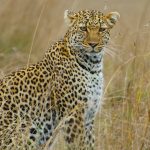
Our eyes were scanning the vegetation, listening for calls and searching for some of Kenya’s fascinating bird species when the safari suddenly took an unexpected turn. There, seemingly out of nowhere, stood one of Africa’s most elusive predators – a Leopard (Panthera pardus).
For a few precious moments, the leopard appeared to be moving with purpose through the habitat, seemingly alert and possibly searching for an opportunity to hunt. Leopards are predominantly solitary predators and are remarkably adaptable, occupying a wide range of habitats from savannas and woodlands to forests, rocky areas and riverine environments. Their activity is often concentrated around cooler periods such as dawn and dusk, although they can also be active during daylight hours depending on conditions and disturbance. Research on leopards in central Kenya has, in fact, documented considerable variation in their activity throughout the day, with notable movement around sunrise and sunset.
Then came the moment.
The leopard paused and looked directly towards us, almost as if saying: “capture the moment before I disappear.”
We did exactly that.
A few clicks of the camera later, the spotted predator turned away and melted into the tall grass and thick bush bordering the riverine woodland. Within seconds, it had vanished – swallowed by the very habitat that makes leopards such extraordinary masters of concealment.
That ability to disappear is more than an illusion. The leopard’s rosette-patterned coat provides remarkable camouflage among broken shadows, grasses, woodland and dense vegetation. It is also an exceptionally versatile hunter, taking a wide variety of prey, from medium-sized mammals and antelopes to smaller mammals and birds. Studies of hunting leopards have shown that habitat structure and prey availability can strongly influence where and how these predators hunt.
Leopards are also famous for their strength and ability to climb trees, sometimes carrying kills into branches where they can feed with reduced interference from competing predators and scavengers.
Yet perhaps the most remarkable thing about a leopard encounter is not simply seeing the animal – it is appreciating how easily it can remain unseen.
This is why a Kenyan birding safari can sometimes deliver far more than birds. Every trail, riverine woodland, thicket and patch of grassland holds the possibility of an unexpected discovery.
We went looking for birds.
The Leopard found us instead.
And just as quickly as it appeared, it disappeared – leaving us with a handful of photographs, an unforgettable memory, and a renewed appreciation for one of Kenya’s most elusive big cats.
Wild Kenya never quite tells you what is coming next.
Leopard Conservation
The Leopard remains classified as Vulnerable on the IUCN Red List, with habitat loss, declining prey, human – wildlife conflict and other pressures contributing to concerns over populations across its range. Protecting connected habitats and maintaining healthy wild prey populations are therefore important components of leopard conservation.
Every responsible wildlife encounter is also a reminder that these magnificent predators belong in functioning ecosystems where they can hunt, move, reproduce and remain wild.
From birding trails to big-cat encounters, Kenya continues to remind us why its wildlife is worth protecting.

 Kenya
 Rwanda
 Tanzania
 Uganda